The Garden Awakens
Anise 'Woodland Red' ( Illicium floridanum ) A few weeks ago, I thought spring would never arrive, but now the change is astonishing. The nights are still cold (40s and sometimes even 30s) so planting tender annuals and vegetables is unwise although I have already succumbed, but covering and uncovering things gets old quickly. Someone made a wise comment last week and I must agree with them - "Don't plant anything tender until after May 1". Several plants are blooming like never before. One is the Anise shrub (above and below). I don't know if the recent tree pruning, which is allowing more sun into the woodland path, is affecting it or perhaps it is just age, but I've never seen so many blooms. Michael refers to this as "the stinky fish shrub" and I have to admit to smell of the flowers is quite unpleasant. It is so beautiful that I can overlook that. The old pink dogwood tree, which was already here, shades our woodland path and it too is prett
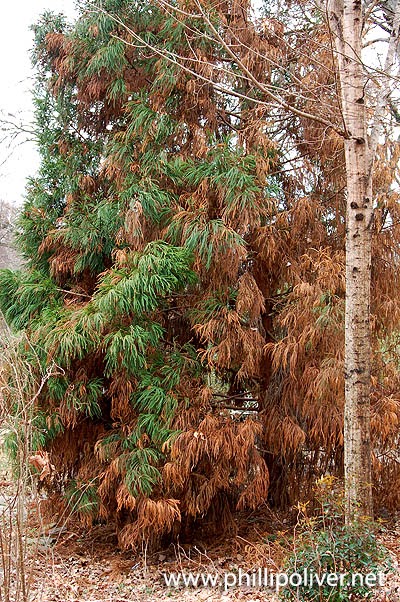


It will be interesting to hear the diagnosis. It sure doesn't look good. Good luck.
ReplyDeleteI am sorry I cannot help you on this, and I do so hope your lovely tree recovers. Keep us posted.
ReplyDeletelooks close to the road - you don't think it got salted during all the snow events do you?
ReplyDeleteNot sure of the prognosis, but we're noticing more brown than normal on ours in Atlanta. It's not nearly as extreme as yours, though. The local extension agent here said he's concerned that it's just a delayed reaction to the drought of the past couple of years, and there's nothing to do but wait and see.
ReplyDeleteoh, no! what a disappointment - doesn't look good? Please let me know what you find out.
ReplyDeleteTim, I hope you are right.
ReplyDeleteDavid, it is not near the street. That is a rock pathway you are seeing in the background.
Leaf blight, leaf spot or fungi can cause inner foliage and tips to turn brown, also drying winter winds from what I've read. Hope it recovers, it's such a pretty tree. I have several stressed trees from the drought and a few dogwoods with shattered bark from late freezes. Mary
ReplyDeleteThat does not look good Phillip. Not normal either. Have you changed anything to do with the soil around the tree or has it recieved more water than usuall this winter? It could even be Phomopsis Twig Blight. In our region (Nashville) we tell people not to "baby" their Cryptos but that does not look like the case here. I would contact an ISA Arborist and see if he can help.
ReplyDeleteI enjoy your blog.
Connor, Associate ASLA
This comment has been removed by the author.
ReplyDeleteActually here is your blight:
ReplyDeleteCercospora Needle Blight
Cercospora needle blight, caused by the fungus Cercosporidium sequoiae (syn. Asperisporium sequoiae; Cercospora sequoiae), is a relatively new disease on Leyland cypress. However, it a common disease on species of Juniperus, Thuja, Cupressus, Taxodium, Cryptomeria, Sequoia and other genera. The first symptom of Cercospora needle blight is a browning of the needles in the lower crown next to the stem. The disease slowly spreads upward and outward until, in severe cases, only the needles at the tips of the upper branches remain green. In a general way, these symptoms mimic those caused by severe stress where the interior needles turn yellow and fall off. Fruiting bodies of the fungus appear as tiny, greenish pustules on the upper surface of the needles or on small twigs. Spores (conidia) are present throughout the spring and summer and are spread by wind. Infection usually occurs during periods of wet weather.
Cercospora needle blight can be controlled by spraying with copper-containing fungicides. There are no fungicides registered specifically for the disease on Leyland cypress, but Kocide is registered for general use on ornamentals. Spray plants at 10-day intervals from bud break until new growth matures.
Phillip, Connor's comments sound "right on the money" to me. I would guess that a copper spray certainly couldn't hurt, but the real question is the feasibility from a financial point. We lost an oak a couple of years ago to a gall that decimated it over a few years. There is a spray to correct it, but who can afford a giant cherry picker coming to our homes every 10 days to hit a tree that size with spray? I wonder if there is a systemic that could be injected (still not cheap, though).
ReplyDeleteConnor, I can't thank you enough! Do you think it is too late to apply the copper fungicide?
ReplyDeleteI'm no tree expert, but from a northern point of view, we can often get 'winter kill'. If the fall was a bit dry, and there were a lot of cold drying winter winds. The bushes usually recover from resprouting farther inward which it looks like yours is doing.
ReplyDeleteIs the deadest looking part facing the direction your wind would have come from?
If so, that's my guess.
It looks to me that with that amount of damage, the tree may be beyond saving. I do agree that some of it may be winter kill or stress due to the blight, but i would guess that if you had an arborist look at it, they would not be able to save her. I would still have one look. Check this link http://www.isa-arbor.com/faca/findArborist.aspx
ReplyDeleteto find one that is ISA certified.
You should be able to find one that will do a consultation for free and then charge you for any work needed.
Please keep us informed and I hope I have been wrong!
I can't add much to what has already been said, but I do this species is occasionally prone to damage from sweeping winter winds. If so it should recover. If it was my tree I would prefer that diagnosis to that of a fungal infection; spraying something that large will be an ordeal.
ReplyDeleteHey Phillip,
ReplyDeleteGosh, I don't know, but that brown stuff is scary. I hope it's OK.
Saw your article on "dill" in the AL. magazine. I've been meaning to subscribe to that magazine, but don't remember doing it. HMMMMM.
Your poor tree - I hope you can save it. We have the same problem on a couple of big Leylands although not as extensive. Ours are in a relatively protected area so I don't think it's wind. Thanks to Connor for explaining what it might be - going to try the copper fungicide.
ReplyDeleteOh Phillip I hope it's able to recover~I can't believe the damage this winter's brought our gardens. gail
ReplyDeleteI wish I knew the answer for this one...but I'm crossing my fingers for you!
ReplyDeletePhillip, the last time I speced Cryptomeria in a design, my contractor asked me to substitute another conifer. He said the Crypts are subject to a blight, since he is the one who guarantees the plants he wouldn't install them. Hope this is not the case with yours.
ReplyDeleteDid you anger any Alabama fans??
ReplyDeleteDid the cryptomeria survive? Several of mine have the same problems that started in Fall this year in Mississippi.
ReplyDeleteChad, I thought it had tied and removed the lower branches. It was still alive,however, and began to sprout new growth. I do not live there anymore and I have not asked the present owners what has happened since I left but I will.
ReplyDeleteFor seven years our cryptomeria grew strong and healthy. Then we planted a small grafted apple tree about seven feet away from it. Within three years, the cryptomeria, which has always naturally had some hollow but green areas, started turning brown around and inside of the hollow. AND in the spring and summer, the leaves and fruit skin of the apple tree developed 1/2” brown spots all over. I read up on it and discovered that evergreen trees and apple trees pass some kind of blight back and forth to each other on a seasonal basis. The apple tree harbors it during spring and summer. The evergreen gets it for fall and winter! SO, I cut down trees he apple tree this fall (they were practically touching each other. I read that apple trees should not be planted near evergreen trees. Two hundred feet away or more is recommended.
ReplyDeleteWe did have very hot and dry weather this summer. Then this fall we have had bad storms, some high winds and 4” of rain in a day a couple of times. Now we are getting ready for frost. This has been a rough plant year.
One year our mature fern cypress tree got turned brown by some kind of wormy thing, hanging all over the tree while we were gone for two summer weeks. It looked SO BAD, my husband talked about cutting it down. But we decided to see if it would recover the following growing season. Over the next three years, it totally recovered. I did not know that an evergreen could ever recooperate, but that one did. (We did spray for the worms when we got back from vacation)
My cryptomeria began turning brown last summer, after an unusually hard winter with cold, rough winds. This year the brown is worse and I cut part of it off - but now vigorous green shoots are appearing on the branches. I have been unable to determine if the cold winter caused the browning, or inadequate watering, or blight (looked for "tiny green pustules" and ccouldn't find any.) I'm very fond of the tree and am going to give it more time, and I've also planted a new Monrovia Virginia creeper on the unsightly brown area.
ReplyDeleteSo happy that you asked a question that has been haunting me for the last couple of years. I feel encouraged to cut that sucker down.
ReplyDeleterickii
Hi-- We have a row of 7 cryptomeria Japonica in our backyard. Last year two of them (next to each other) turned completely brown and I guess we waited a year and then gave up and chopped them down. A third one started turning brown and we held off on chopping it down and lo and behold, it is now getting its color back--although not as green as the others. We had a tree expert come and have a look before we chopped them down and he had no idea what had happened to them. He said maybe we planted the root ball to compact? Anyway, now we have a big gap in our row of huge trees and the back neighbor's house shows threw. So sad! :(
ReplyDelete