My main reason for visiting Washington D.C. was not to see the White House or the Lincoln Memorial or any of the other monuments - I wanted to see Dumbarton Oaks, a garden that I've studied and revered for years. I reviewed a book about the creation and history of this fabulous garden -
Dumbarton Oaks: Garden Into Art
- and I highly recommend it. From the photos I'd seen and what I'd read, it was my ideal garden. It has inspired me in my own garden and I couldn't wait to see it with my own eyes. Granted, August was not the ideal time to visit but the opportunity was there and I took it. I was not disappointed in the least - this is a garden known as much for its brilliant architecture and tactile elements than for the plants that adorn it. I do want to go back and see it again, both in the fall and spring, so I hope this won't be my first and final visit.
I was disappointed that no one seemed familiar with Dumbarton Oaks. The concierge at our hotel gave us a blank stare when we asked about it and the cab driver told us he'd never heard of it. I suppose a garden is not the first thing that comes to most people's minds on a visit to Washington D.C. Oh well, I've always marched to a different drummer!
My friend Rebecca and I toured the garden on a blazing hot Tuesday afternoon (it is open from 2-6pm only) and we practically had the garden to ourselves until a group of design students showed up toward the end. Despite the heat, I thought I had found heaven. I took over 200 photos - here is a small sample.
 |
| Rebecca enjoying one of the views |
 |
| The Orangery |
|
 |
| A section of the front lawn |
 |
| Close to the entrance to the property is this magnificient spreading
katsura tree (in the background), one of the oldest trees on the
property. It was planted in the 19th century. Next to it is an ancient
Japanese maple (in the foreground) with a spread of over 70 feet. |
 |
| The front of the house |
 |
| The back of the house is also restrained with plantings.
The elaborate gardens (below) are to the left of the house on a sloping
hillside. |
 |
| Detail of the grass steps on the back lawn. |
 |
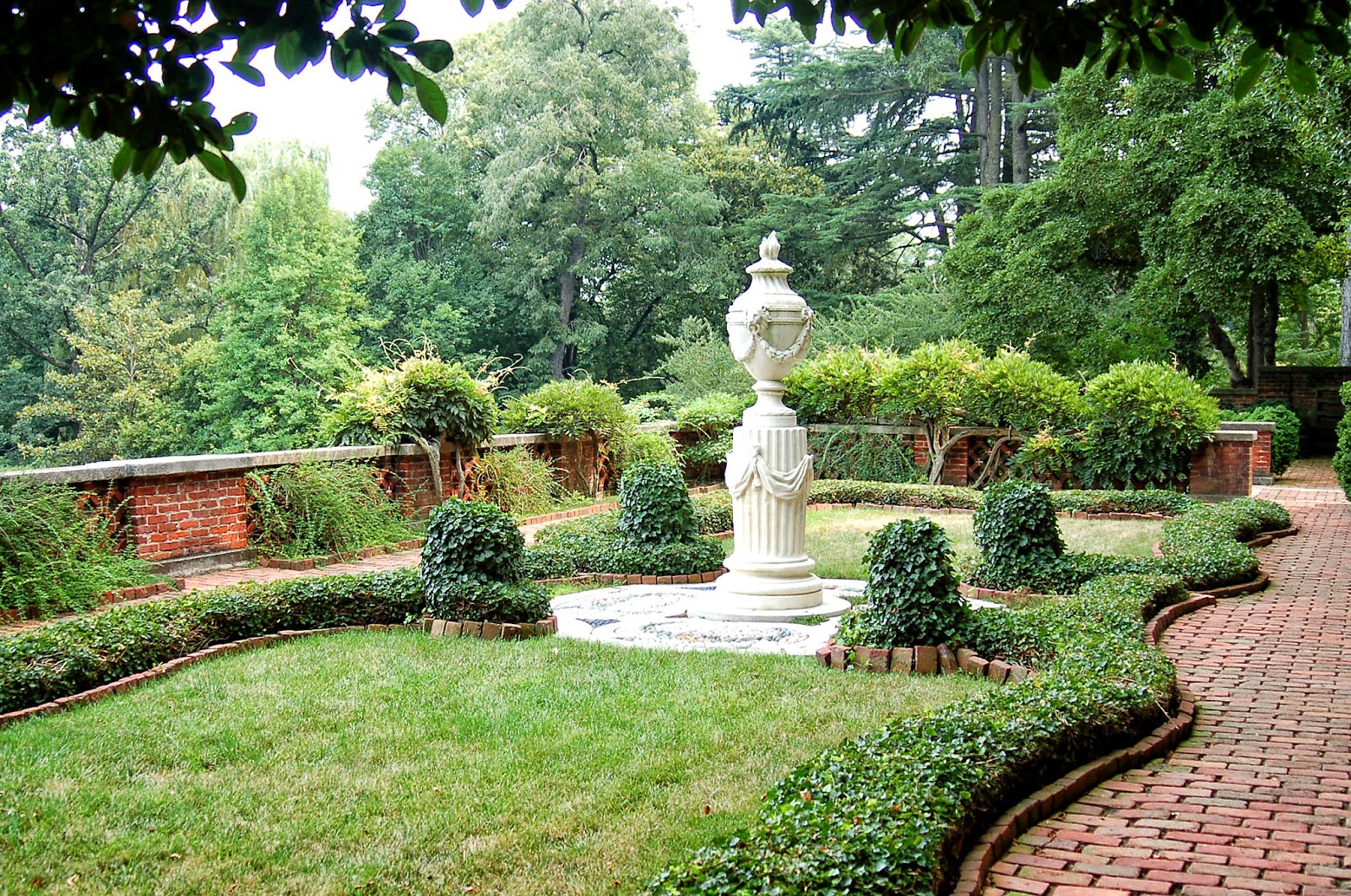
| This is the Urn Terrace which overlooks the rose garden and the lower
gardens. Notice the exquisite brick work - although brick is used
extensively throughout the gardens, other types of stone (slate,
concrete, pebbles, etc.) are used as well. One of the things I learned
from this garden is that it is okay to mix materials. |
 |
| The Rose Garden lies just below the Urn Terrace and above the
Fountain Terrace. The roses here are hybrid teas and there were not too
many blooming. The tomb of Robert and Mildred Bliss can be seen at the center of the wall. |
 |
| The walls of the Rose Garden (the Urn Terrace sits right above this area). |
 |
| A bench in the Rose Garden inscribed with the motto "Quod
Severis Metes" ("As you sow, so shall you reap"). The ornament at the
top of the bench is actually the top of the ornamental section of the
Fountain Terrace (you can see it in the next photo if you look closely).
Ingenious! |
 |
| This was my favorite area of the garden. It is the Fountain Terrace
which features two matching lead fountains. The plantings in this area
change with the seasons. |
 |
| Or maybe this was my favorite area - the Arbor Terrace. I believe this
was Mrs. Bliss's favorite spot in the garden. The coolest area of the
garden was inside this arbor which is covered with a massive wisteria. I
would love to see it in bloom! There is a charming wading pool inside
and (don't tell anyone), I took a dip! The containers outside were
filled with tropical plants like oleander and coleus. |
 |
| Inside the arbor with the wading pool in the foreground. |
 |
| This is the famous Ellipse, comprised of a double row of American
Hornbeams that have been clipped into an aerial hedge 16 feet high and
15 feet wide. An antique Provencal fountain sits in the center of the
circle. Very elegant, very restrained. |
 |
| The Lovers Lane Pool is a miniature Roman-style amphiteater made of brick rows that overlook a shallow pool. |
 |
| In the sweltering heat, the pool looked so inviting. It was actually closed off so that you could not walk around it. |
 |
| Inside the Loggia, artist Allyn Cox, who also painted murals in the rotunda of the US
Capitol, developed a series of canvas frescoes for the ceiling and walls, depicting the fable of Diana and Actaeon. When the
paintings declined in the 1940s, they were reproduced in three mosaic
panels of Portuguese tile. |
 |
The Pebble Garden was the last major feature to be added at Dumbarton
Oaks. This was a former tennis court that was covered with a huge motif
made from pebbles and is usually covered with a shallow sheet of water
although when I was there only the fountains at the head of the design
were
running. This area lies just beneath the pool area. |
 |
| In early August, most of the color in the garden was in the Cutting Garden and the Herbaceous Border. They were a riot of color. |
 |
A monument commentating the work of Beatrix Farrand, the woman
who created this beautiful garden. |




Comments
I would have loved to see the shallow sheet of water over the converted tennis-court garden. Great pictures! Thanks for sharing them.
good for you for taking a dip!
Yhis garden is very inspiring. Thank you for sharing this!
~Alyse in Oregon
Alyse