Growing Roses 101
After my last post, I received a lot of questions about growing roses. I'm not a rosarian but I can share some thoughts on what I've learned from growing roses over the past 20 years. And if that doesn't interest you, enjoy the photos of more roses that I took yesterday afternoon.
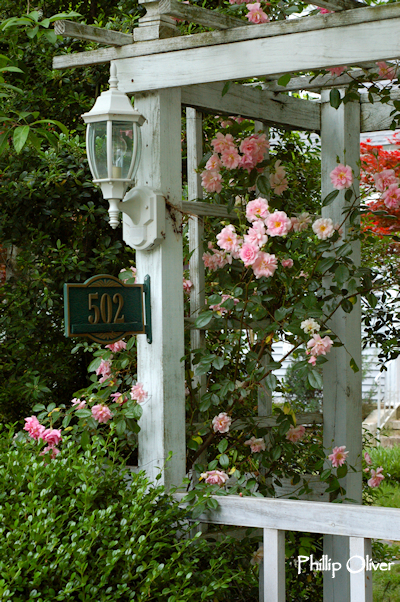
The climbing rose 'Climbing Pinkie' at the front gate

I love roses - when I first started gardening, that was the plant I wanted to grow. Like most beginning rose growers, I bought hybrid tea roses because that is mainly what the local nurseries sell. Mistake number #1! Unless you have a lot of time on your hands (like being retired!), caring for hybrid teas might be a discouraging experience. I realized quickly that I just didn't have time to spray, prune, fertilize and coddle these roses to keep them looking their best. I love spending time in the garden but not doing that. I'm also pretty much an organic gardener - I will use chemicals on occasion but only in extreme situations. After battling blackspot (which is inevitable) and other woes, I discovered antique roses, or "old roses" as some people call them. These roses don't have all the hassles that hybrid teas do and to my eye, they are more beautiful.
An old Bourbon rose 'Maggie'

I like the look of these roses. Hybrid teas tend to look like blooms on thorny sticks whereas most old roses are fuller. I think they look great in the landscape. I love big shrub roses that cascade to the ground and climbing roses that cover arbors and gates.
'Buff Beauty' on the left - the rugosa rose 'Hansa' can be seen in the distance to the right (click on photos for a larger view)

Old roses do have a few drawbacks. Most only bloom once in the spring so unlike hybrid teas, you don't have blooms all summer. Some can get very large but there are also others can stay smaller. There are certainly varieties that are excellent choices for smaller gardens.
This rose, 'Marie Pavie' is an excellent little rose that I would highly recommend. It doesn't get above 3 ft. high, I've never seen blackspot on it, and it blooms off and on all summer long. Another plus, mine gets mostly shade - just a few hours of direct sun in late afternoon. What more could you ask for?

I really love the climbers. Here are a few that are blooming right now.
'Sombreuil'

'Sally Holmes'

And several shot of 'Climbing American Beauty'


There are many different classes of old roses, far too big of a subject to go into here (check my website for more in-depth information). Some do better in the south than others. Hybrid perpetuals and rugosas, for example, perform better in northern climates. I've tried a lot of them and if a rose is being a pain, I've learned that the best thing to do is just dig it up and try another one.
Pruning - The only pruning I do is to cut out dead wood or if I'm trying to restrain certain plants. After the roses finish blooming in late spring I'll cut back wayward canes on my arches and pergolas. Sometimes I'll cut a rose back severely if it looks scraggly. It all depends on the rose - some grow differently than others and require more attention. The best time to prune roses in very early spring, right before new growth has started. The old saying "Prune when the forsythia blooms" is great advice. Do it then.
Fertilizing - After these roses are established, fertilizing with commercial feed is not a requirement. The best thing you can give them is organic matter. I mulch mine every year (sometimes twice a year) with rotted leaves, pine straw or humus, which breaks down and makes the soil rich. This gives these roses plenty of nutrients. Aged cow manure (or really any type of manure) is excellent. During the growing season, I use fish emulsion which is a great fertilizer for just about any plant. I don't adhere to a strict fertilizing schedule. I add mulch and organic matter in the fall and spring and use the liquid fish fertilizer during the season when they are growing.
Japanese Beetles - A lot of people have asked me about these pests. Yes, I do have them and no, I don't have a good answer as to how to control them. The good news is that they arrive in June after most of the roses have finished blooming. There are some roses that are still around though and seeing them swarmed by these devouring creatures can be discouraging. The best thing to do is to take a bowl of soapy water out and knock them off. Other options are applying milky spore to your lawns. This kills the grubs that turn into the beetles but it will take a few years before it is effective. I would not recommend using the Japanese Beetle traps. I've heard that they attract more beetles to your garden and unless your neighbors are doing something to combat theirs, it is a never-ending process.
Buying them - You may occassionally find old roses at local nurseries but that is very rare. I rely on mail order nurseries and I have listed my favorite sources below. The Antique Rose Emporium, headquartered in Texas, had a gorgeous facility in Dahlonega, Georgia. Michael and I used to take a trip there every year (about 5 hours from us) and come home with a truck load of roses. We heard that a wealthy foreign investor and his wife feel in love with the place and offered them so much money that they couldn't refuse. It was a beautiful setting - an old house that had been renovated and surrounded by a beautiful rose garden - but I digress.
Here are the best sources for old garden roses:
Chamblees Rose Nursery in Tyler Texas - They have the best prices and I've never received a bad plant from them. They don't have a huge selection though and they are often out of stock on certain varieties. Plan ahead!
Antique Rose Emporium in Brenham, Texas - I haven't ordered from them in a while. I preferred going to their branch in Dahlonega, Georgia. Their website is very friendly and beautiful.
Roses Unlimited in Laurens, S.C. - Their website leaves a lot to be desired but they have the most impressive selection of plants. I've actually visited them and they are really nice people. Pat Henry, one of the owners, has a beautiful rose garden that has been featured in several publications. The roses that I've ordered through the mail have always been super healthy and large. Just give them a call.
If you have any more questions, just let me know!
An old tea rose called 'Lafter'

The climbing rose 'Climbing Pinkie' at the front gate
I love roses - when I first started gardening, that was the plant I wanted to grow. Like most beginning rose growers, I bought hybrid tea roses because that is mainly what the local nurseries sell. Mistake number #1! Unless you have a lot of time on your hands (like being retired!), caring for hybrid teas might be a discouraging experience. I realized quickly that I just didn't have time to spray, prune, fertilize and coddle these roses to keep them looking their best. I love spending time in the garden but not doing that. I'm also pretty much an organic gardener - I will use chemicals on occasion but only in extreme situations. After battling blackspot (which is inevitable) and other woes, I discovered antique roses, or "old roses" as some people call them. These roses don't have all the hassles that hybrid teas do and to my eye, they are more beautiful.
An old Bourbon rose 'Maggie'

I like the look of these roses. Hybrid teas tend to look like blooms on thorny sticks whereas most old roses are fuller. I think they look great in the landscape. I love big shrub roses that cascade to the ground and climbing roses that cover arbors and gates.
'Buff Beauty' on the left - the rugosa rose 'Hansa' can be seen in the distance to the right (click on photos for a larger view)

Old roses do have a few drawbacks. Most only bloom once in the spring so unlike hybrid teas, you don't have blooms all summer. Some can get very large but there are also others can stay smaller. There are certainly varieties that are excellent choices for smaller gardens.
This rose, 'Marie Pavie' is an excellent little rose that I would highly recommend. It doesn't get above 3 ft. high, I've never seen blackspot on it, and it blooms off and on all summer long. Another plus, mine gets mostly shade - just a few hours of direct sun in late afternoon. What more could you ask for?

I really love the climbers. Here are a few that are blooming right now.
'Sombreuil'

'Sally Holmes'

And several shot of 'Climbing American Beauty'


There are many different classes of old roses, far too big of a subject to go into here (check my website for more in-depth information). Some do better in the south than others. Hybrid perpetuals and rugosas, for example, perform better in northern climates. I've tried a lot of them and if a rose is being a pain, I've learned that the best thing to do is just dig it up and try another one.
Pruning - The only pruning I do is to cut out dead wood or if I'm trying to restrain certain plants. After the roses finish blooming in late spring I'll cut back wayward canes on my arches and pergolas. Sometimes I'll cut a rose back severely if it looks scraggly. It all depends on the rose - some grow differently than others and require more attention. The best time to prune roses in very early spring, right before new growth has started. The old saying "Prune when the forsythia blooms" is great advice. Do it then.
Fertilizing - After these roses are established, fertilizing with commercial feed is not a requirement. The best thing you can give them is organic matter. I mulch mine every year (sometimes twice a year) with rotted leaves, pine straw or humus, which breaks down and makes the soil rich. This gives these roses plenty of nutrients. Aged cow manure (or really any type of manure) is excellent. During the growing season, I use fish emulsion which is a great fertilizer for just about any plant. I don't adhere to a strict fertilizing schedule. I add mulch and organic matter in the fall and spring and use the liquid fish fertilizer during the season when they are growing.
Japanese Beetles - A lot of people have asked me about these pests. Yes, I do have them and no, I don't have a good answer as to how to control them. The good news is that they arrive in June after most of the roses have finished blooming. There are some roses that are still around though and seeing them swarmed by these devouring creatures can be discouraging. The best thing to do is to take a bowl of soapy water out and knock them off. Other options are applying milky spore to your lawns. This kills the grubs that turn into the beetles but it will take a few years before it is effective. I would not recommend using the Japanese Beetle traps. I've heard that they attract more beetles to your garden and unless your neighbors are doing something to combat theirs, it is a never-ending process.
Buying them - You may occassionally find old roses at local nurseries but that is very rare. I rely on mail order nurseries and I have listed my favorite sources below. The Antique Rose Emporium, headquartered in Texas, had a gorgeous facility in Dahlonega, Georgia. Michael and I used to take a trip there every year (about 5 hours from us) and come home with a truck load of roses. We heard that a wealthy foreign investor and his wife feel in love with the place and offered them so much money that they couldn't refuse. It was a beautiful setting - an old house that had been renovated and surrounded by a beautiful rose garden - but I digress.
Here are the best sources for old garden roses:
Chamblees Rose Nursery in Tyler Texas - They have the best prices and I've never received a bad plant from them. They don't have a huge selection though and they are often out of stock on certain varieties. Plan ahead!
Antique Rose Emporium in Brenham, Texas - I haven't ordered from them in a while. I preferred going to their branch in Dahlonega, Georgia. Their website is very friendly and beautiful.
Roses Unlimited in Laurens, S.C. - Their website leaves a lot to be desired but they have the most impressive selection of plants. I've actually visited them and they are really nice people. Pat Henry, one of the owners, has a beautiful rose garden that has been featured in several publications. The roses that I've ordered through the mail have always been super healthy and large. Just give them a call.
If you have any more questions, just let me know!
An old tea rose called 'Lafter'


Comments
I second your recommendation for the Antique Rose Emporium. Nothing beats a personal visit because their 20-year-old gardens are extensive and beautiful. But their website is filled with great info and pics, and their service and delivery are first-rate. Several independent nurseries here in Austin sell the Rose Emporium's roses also.
Gail
I'm an old rose fan, and though some folks think the spring only blooms are a drawback, the once bloomers pump out more blooms at one time than do the repeat-bloomers.
PLUS, there's a bonus! Companion Planting. I have Clematis going in many of my old roses. The clems begin blooming with the roses, then most (I select for this) continue bloom through September or October. Roses and Clematis seem made for each other!
Most of my old roses (I have about 150) have come from Vintage Gardens in California, but there are other great places: Chamblees in Texas, Roses Unlimited and Ashdown in South Carolina...
Anyhow... Your garden is a dream! Thanks for sharing!
Jan
Always Growing
I had to read your post a few times before I could comment;there was so much of interest here.
First of all visiting your blog is like visiting a beautiful garden in person. The image which you can click on to make larger is a great touch to bring us in.Your garden is what I have always imagined a great Southern garden to be.
Solid advice is found in this post, and great resources for gardener who has never planted a rose before, and for the rosarian specialist. Your comments on hybrid teas and old roses are invaluable.
The different ways you use roses in the garden is instructive and enchanting; spreading bush varieties and climbers on Gothic arbors.
Thank you for sharing your beautiful garden and expertise.
Sincerely,
Philip
I've just found your 'Evolution of the garden.' What a wonderful documentary and what an amazing amount you've got done. We've done much less in 10 years. Although I suppose that's partly because we started in a pine forest rather than a field. You inspire me to see if I can find some early photos and create something similar.
Thank you.
I have had no luck with climbing roses. They always die back to the base. I don't know what i'm doing wrong. But my srub roses do very well. And here in Michigan, the roses start blooming about 2 weeks before the beetles get them.
And I agree with you about the hybrids, too much work!
Frances at Faire Garden
Thank you in advance for your advice,
Debbie
Did your rose come in a pot or a bag? I'm thinking that your roses have probably been waxed - do you know? If so, they are dormant now if you don't see any new leaves coming out. I would store them but I'm thinking that a bright warmer spot might be better than a cold dark one. The important thing is to not let the roots dry out, but if they are wrapped tightly in plastic, they are probably okay.
I am not too familiar with growing roses in California so I hope I'm telling you right. You might want to look up a rose society in your area and ask them about it. I would be interested in hearing what they tell you.
Good luck!
Phillip
FlowerLady