
I'm worried about the Cryptomeria
{{Read an update to this post here}}
For the past month or so, I've noticed that our big Japanese Cedar (Cryptomeria japonica) has been turning brown. I know that it usually does this but I don't recall seeing it to this extent. The entire backside of the tree looks completely brown and the opposite side is slowly turning brown also. Is this normal???

I can see new growth sprouting out from some of the branches. I hope this is a good sign that nothing is wrong.
If any tree experts can weigh in on this, I'd appreciate it!


Text and photos by Phillip Oliver, Dirt Therapy
For the past month or so, I've noticed that our big Japanese Cedar (Cryptomeria japonica) has been turning brown. I know that it usually does this but I don't recall seeing it to this extent. The entire backside of the tree looks completely brown and the opposite side is slowly turning brown also. Is this normal???
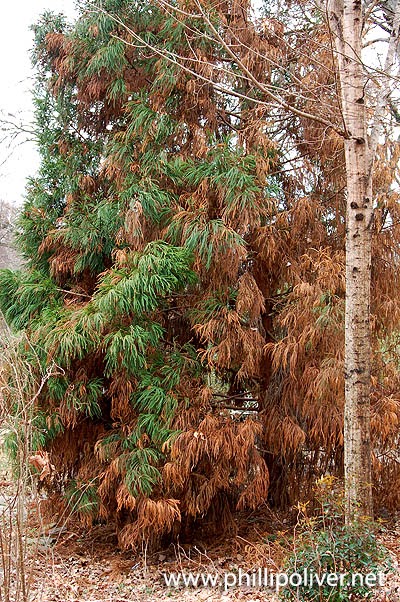
I can see new growth sprouting out from some of the branches. I hope this is a good sign that nothing is wrong.
If any tree experts can weigh in on this, I'd appreciate it!


Comments
David, it is not near the street. That is a rock pathway you are seeing in the background.
I enjoy your blog.
Connor, Associate ASLA
Cercospora Needle Blight
Cercospora needle blight, caused by the fungus Cercosporidium sequoiae (syn. Asperisporium sequoiae; Cercospora sequoiae), is a relatively new disease on Leyland cypress. However, it a common disease on species of Juniperus, Thuja, Cupressus, Taxodium, Cryptomeria, Sequoia and other genera. The first symptom of Cercospora needle blight is a browning of the needles in the lower crown next to the stem. The disease slowly spreads upward and outward until, in severe cases, only the needles at the tips of the upper branches remain green. In a general way, these symptoms mimic those caused by severe stress where the interior needles turn yellow and fall off. Fruiting bodies of the fungus appear as tiny, greenish pustules on the upper surface of the needles or on small twigs. Spores (conidia) are present throughout the spring and summer and are spread by wind. Infection usually occurs during periods of wet weather.
Cercospora needle blight can be controlled by spraying with copper-containing fungicides. There are no fungicides registered specifically for the disease on Leyland cypress, but Kocide is registered for general use on ornamentals. Spray plants at 10-day intervals from bud break until new growth matures.
Is the deadest looking part facing the direction your wind would have come from?
If so, that's my guess.
to find one that is ISA certified.
You should be able to find one that will do a consultation for free and then charge you for any work needed.
Please keep us informed and I hope I have been wrong!
Gosh, I don't know, but that brown stuff is scary. I hope it's OK.
Saw your article on "dill" in the AL. magazine. I've been meaning to subscribe to that magazine, but don't remember doing it. HMMMMM.
We did have very hot and dry weather this summer. Then this fall we have had bad storms, some high winds and 4” of rain in a day a couple of times. Now we are getting ready for frost. This has been a rough plant year.
One year our mature fern cypress tree got turned brown by some kind of wormy thing, hanging all over the tree while we were gone for two summer weeks. It looked SO BAD, my husband talked about cutting it down. But we decided to see if it would recover the following growing season. Over the next three years, it totally recovered. I did not know that an evergreen could ever recooperate, but that one did. (We did spray for the worms when we got back from vacation)
rickii